 Creative Expert Hub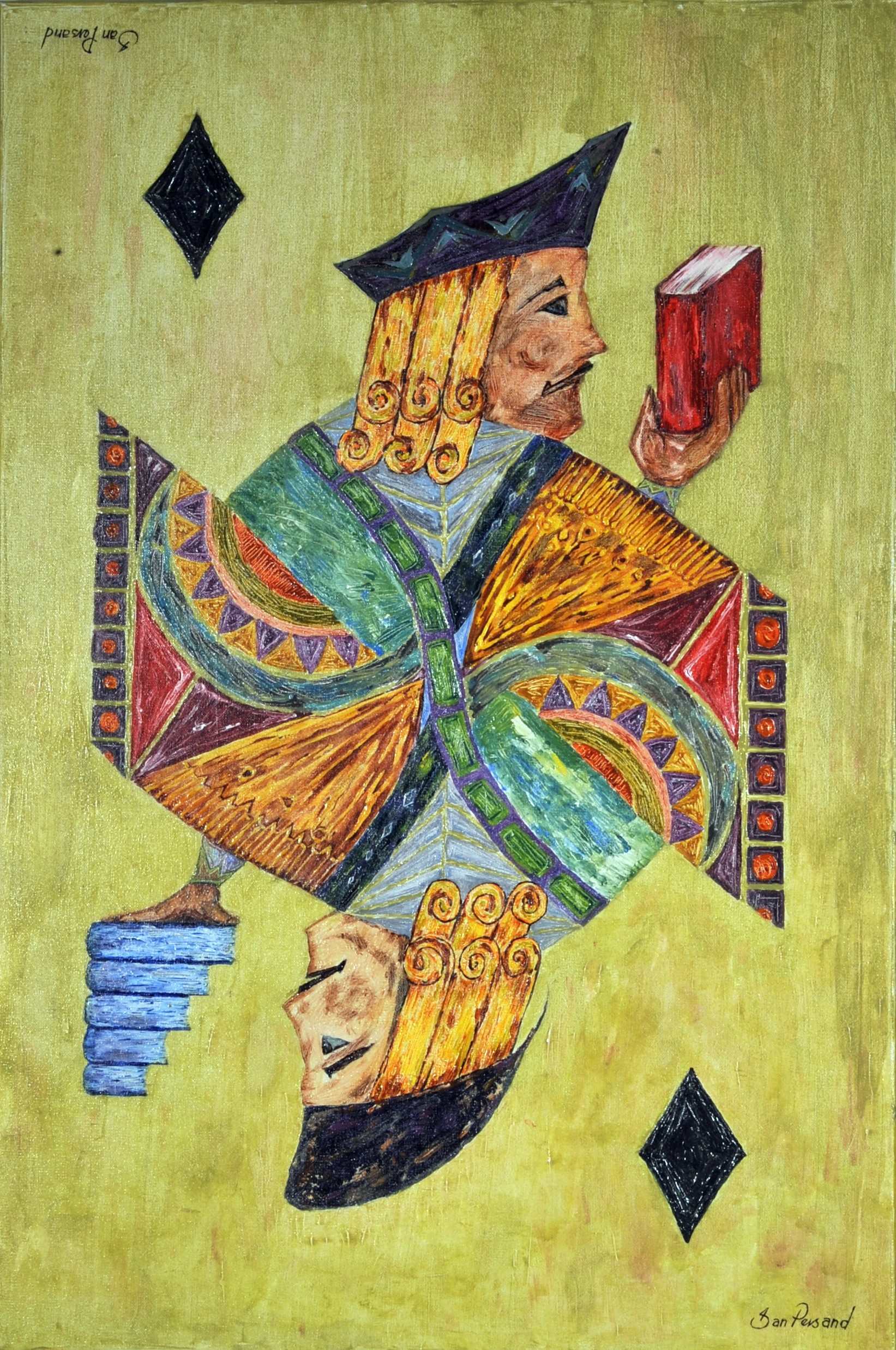
Transsystemia
Civil Law and Common Law
About the Piece
Civil Law and Commom Law are the world’s two major legal systems. McGill University has a long history of teaching both legal systems in a comparative and bilingual fashion. The university is itself situated in Montreal, Quebec: a bilingual city in a bijural province, where the actual legal system is a mixture of both civil law and common law. This unique approach to legal teaching is called the transsystemic method.
Transsystemia aims at comparing and contrasting the two main legal systems, highlighting their strengths and weaknesses. It also ensures that students obtain a cosmopolitan understanding of the law to better tackle complex legal issues.
This painting represents the transsystemic approach to law: the way it is studied, understood and applied. The painting shows how both legal systems can coexist side by side on the same playing card and in the same legal sphere. While throwing a playing card on table, it doesn’t matter if the card lands upside down as long as it falls on its face. In fact, there is no upside down because of the card’s mirror image. What matters is the strength of the card.
Half of the painting represents the Civil Law and the other half represents the Common Law. Both legal systems when thrown on the table, aim at achieving the same outcome: to do justice. Our society has a set of rules and people have to play by these rules to win their way through. Similarly in a game of playing cards there are rules and without rules there is no winner. No matter which hat is being worn by the Judge and which legal system is being used to judge a case, justice has to prevail and the final result shall be the same.
The opposite images in the painting are essentially the same, with minor differences characterizing each legal system. These details show to what extent the procedures in each legal system are complex. In both systems the jurist has to navigate through a maze of procedures to reach a final decision.
For some people, law is too abstract or complicated to be understood. Others even believe law is absurd. As everything else, for sure there are laws that become obsolete with time however, if one doesn’t understand their meaning and context doesn’t mean the law is absurd. The vivid colors and symmetrical patterns reveal how both the Civil Law and the Common Law are delicately structured.
The painting also shows the different approach of each legal system. Common Law of Canada originates from English Law, and Civil Law of Quebec comes from French Law. The Civil Law is characterized by the Civil Code. Laws in the Civil Code are coded and described in one single red book. However, the Common Law is not restricted to a single book codifying its laws. Common Law has been developed through case laws and precedence. All its laws exist in different manuscripts arising from a series of cases that have evolved through time. Hence, the stack of blue books representing Common Law and precedence. There are other elements of symbolism embedded in this painting for you to discover.
Curious how creative thinking applies to your own work?