 Creative Expert Hub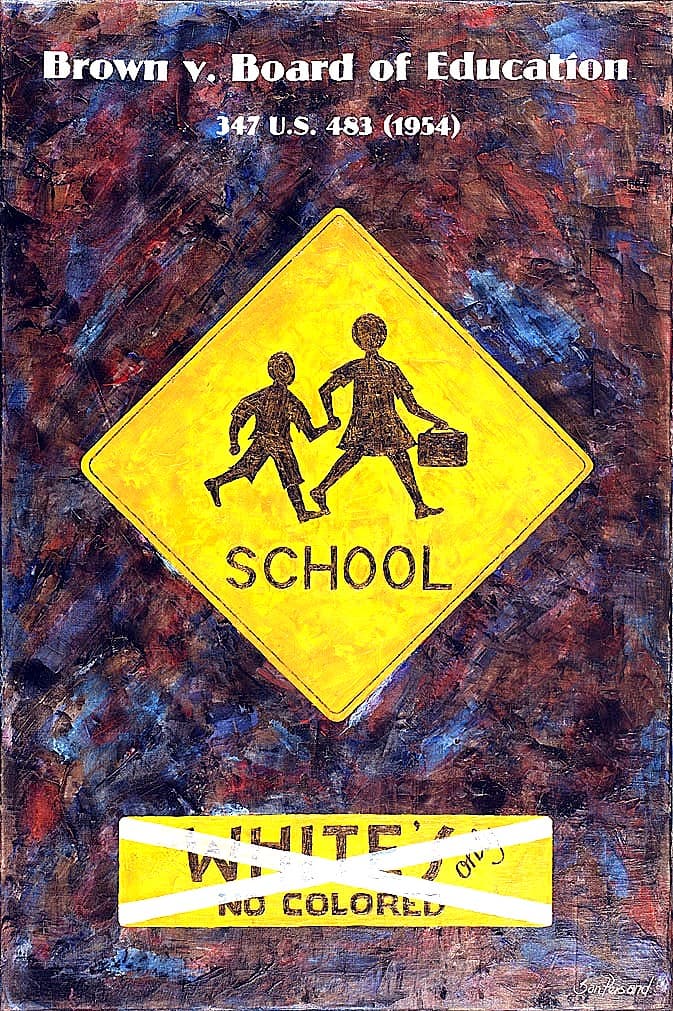
Brown v. Board of Education
347 U.S. 483 (1954)
About the Piece
Brown v. Board of Education is one of the most important cases on racial segregation in the United States. This case, which was decided in 1954 by the US Supreme Court, has been instrumental in paving the way for the long fight towards freedom, equality and integration of black people in the United States.
In the 1950s, racial segregation was the norm everywhere across the United States: in public schools, restaurants, public transport and even in restrooms. Under the "separate but equal" doctrine, it was legally acceptable to have separate schools for black and white children, as long as these schools provided similar facilities. However, most black schools were far inferior compared to white schools: they were crowded, less equipped and poorly funded.
Linda Brown, an African-American third grader walked one mile every day to catch a bus to go to Topeka, Kansas's black elementary school. Another elementary school was just seven blocks away from her home, but she was not allowed to study there because it was reserved for white children only. Linda's father decided to file a lawsuit against the board of education of Topeka, Kansas, calling for the school board to reverse its racial segregation policy. The case went up to the United States Supreme Court where they decided that it was unconstitutional to segregate children into different schools based on their race. Despite this decision, many public schools in the United States were very reluctant to desegregate. In some schools, administrators blocked their school entrance, refusing to admit black children. Police in riot gear had to escort black children who were admitted to white schools, since they were being pelted with stones and racial slurs while crossing white neighborhoods.
My painting is a contemporary representation of the U.S. Supreme Court Decision that brought an end to school segregation and its legal implications. In the 1950s, the standard method of teaching at schools used blackboards and chalk. The background of this canvas represents a blackboard that has been wiped off many times, leaving colored chalk marks all over the surface. This time, the blackboard has been wiped off to write something that would remain for a long time. What was to be written in 1954 would remain on the blackboard for a long time and would change the lives of black children and their parents' hopes for years to come. In this painting, Brown v. Board of Education has been written in white on black, like it would have been written on a blackboard. That day marked a permanent change for the education of black people of the United States.
Signs and indications form part of the landscape of any civilized society. By simply analyzing the different signs displayed in public areas, we get an idea of how a society operates. For instance, a school sign indicates that we value and care for the security of our children. While driving a car, we need to be very careful whenever there are school signs around. These signs remind us that we are in a zone where we might hurt school children if we don't pay enough attention. All children are alike and a country's educational system needs to pay equal attention to all of them regardless of their race or colour.
During these periods of racial segregation, nonwhites were referred to as "colored" because of their skin color. It was common to see signs that read, "White's Only" or "No Colored" in public places all across the United States. In this painting, this powerful sign has been placed below the school sign to illustrate school racial segregation that prevailed before this judicial decision. The outcome of this case was to declare school segregation as unconstitutional. In this painting, the "White's Only, No Colored" sign representing segregation, has been crossed out. Despite crossing out the words on the sign, racial segregation was clearly visible and could still be seen in many schools. The white transparent cross illustrates how schools were reluctant to put an end to segregation, following the Supreme Court decision. Some schools took a long time to embrace this new policy change. For black children, the implementation and acceptance of this new policy was not the end, but the beginning of a long fight towards their integration.
Curious how creative thinking applies to your own work?