 Creative Expert Hub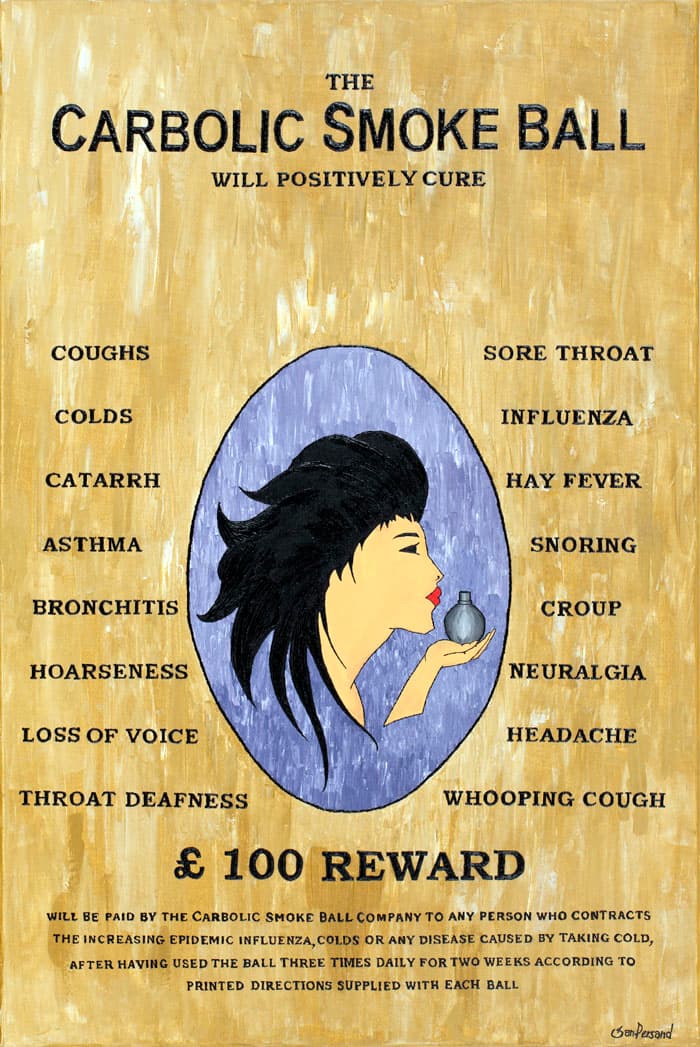
The Carbolic Smoke Ball
Carlill v. Carbolic Smoke Ball Company
About the Piece
Every lawyer who has studied Contract Law in law school must have read the Carlill v. Carbolic Smoke Ball Company case at least once in her lifetime. This famous contract law case from the English Court of Appeal in 1892 has been instrumental in shaping the law of contracts.
In 1891, the Carbolic Smoke Ball Company based in Hanover Square, London, launched a new product destined to cure influenza and a number of diseases. This product called the 'smoke ball' was simply a rubber ball filled with carbolic acid (phenol) with a tube extending from the top. The tube has to be inserted into the nose and the rubber ball pressed to release phenol vapours into the nose of the user. This "amazing" discovery was supposed to cure influenza and many other cold associated complications.
To market its product, the company published advertisements in various newspapers, stating the following: '£100 reward will be paid by the Carbolic Smoke Ball Company to any person who contracts the increasing epidemic influenza, or any disease caused by taking cold, after having used the ball three times daily for two weeks, according to the printed directions supplied with each ball.' In other words, the manufacturing company was so convinced about the efficacy of the Carbolic Smoke Ball that they were ready to pay £100 to anybody whose influenza wouldn't get cured by the product!
Mrs. Carlill saw the advertisement and bought one of the balls, which she used three times daily according to prescriptions for nearly two months. However she contracted influenza. She immediately wrote to the Carbolic Smoke Ball Company to claim her £100 reward, which was then a big sum of money (equivalent to $21,500 USD in today's money). The company told Mrs. Carlill they need her to come to their head office and use the ball everyday for three weeks so that she could be checked by their secretary.
Mrs. Carlill was upset with this reply and decided to sue the company for failing to pay the £100 reward as advertised. The company refused to pay arguing that the product was serious, but the reward was simply a joke. Since the law of contracts was quite basic and restrictive, the Court had to be very creative in finding a way to condemn the company. Eventually the Carbolic Smoke Ball Company was condemned to pay Mrs. Carlill her reward of £100.
Today there are various laws protecting consumers and regulating advertisement. However 100 years ago judges had to extrapolate from the basic principles of contract law to oblige manufacturers pay for their bluff.
My painting replicates the advertisement that was published in the 1891 newspaper while adding a touch of contemporary. I have kept the wordings as they are, but added some colours and facelifted the lady. How funny that the Carbolic Smoke Ball was expected to cure not only influenza but coughs, colds, catarrh, asthma, bronchitis, hoarseness, sore throat, laryngitis, croup, whooping cough, neuralgia, headache and hay fever. This should have been indeed a miracle cure. The paradox is that 100 years later, scientists are still looking for an effective cure for influenza!
The original advertisement figured a Victorian lady pressing a rubber-balled flask. However this contemporary version figures a modern lady holding a fragrance-like flask. The idea of substituting a contemporary face into this century old poster creates a contrast between ancient and modern. This contrast reflects upon the evolution of law since this case was decided in 1892, while showing at the same time that the principles of the common law of contract still remain relevant today.
The Carbolic Smoke Ball case has been read, analyzed and discussed thousands of times. There are not many cases in legal history that have received so much attention. If not for this advert, this case would probably have never existed.
Curious how creative thinking applies to your own work?